Fannie May Chocolates
My Account Shopping Basket Items $0.00 Go to shopping basket
Sign In


History of Chocolate

About Us | Affiliate Program | Chocolate Passion | History of Chocolate | Chocolate Trivia

Careers | Press Releases | Health and Chocolate | What's New


250 Mayas discover cacao
A.D. 250-900 the first people clearly known to have discovered the secret of cacao were the Mayas. These highly civilized people from Central America undertook a massive migration into the northern regions of South America. In Yucatan, the Mayas took the trees from the rainforests and established the earliest known cocoa plantations, where they harvested, fermented, roasted, and grounded seeds into a paste. When mixed with water and other ingredients this paste made a bitter chocolate beverage.

950 Cacao beans as currency
From the very early days of cocoa the Mayas also used cacao beans as a form of payment and this had been established before A.D. 1000. Those wealthy enough to have an excess of beans use them to make a chocolate drink that gives them wisdom and power.

1200 Aztecs adopted cacao
Records from this period indicate that Aztecs and Mayas traded for cacao, but as the Aztecs strengthened their dominance in Mexico and conquered the Mayas, they soon required that conquered people pay their tributes in cacao beans, a form of early money. While in the early Maya society many could drink chocolate at least on occasion, in Aztec society priests presented cacao seeds as offerings to the gods and served this sacred brew primarily rulers, higher soldiers and honored merchants.

1502 Christopher Columbus discovers cocoa bean
On his fourth voyage to America, Columbus ended up in Nicaragua and was the first European to discover cocoa beans and chocolate. Columbus was not interested in cocoa, since he was still searching for the sea route to India.

1513 Payment in beans
Hernando de Oviedo y Valdez, who went to America in 1513 as a member of Pedrarias Avila’s expedition, writes that he bought a slave for 100 cocoa beans. Later on Hernando Cortez builds a cocoa plantation for the purpose of growing money in the name of Spain.

1528 Cocoa in Europe
Cortez, who conquered part of Mexico in 1519, returns back to Spain and brings with him the first cocoa and the tools necessary for its preparation. It has been recorded that he personally found the taste of the chocolate drink distasteful, probably because the Aztecs bitter chocolate drink was seasoned with spices: cocoa paste with water, chile peppers, cornmeal, and other ingredients. Spanish cooks later on replaced the chile peppers for sugar.

1657 First European chocolate store
England’s first chocolate store opens in London’s by a Frenchman in 1657. However, this was an elite occasion. The Spanish historian Oviedo writes: “none but the rich and noble could afford” to shop at such establishments. Enterpreneurial bakers in England begin to add cocoa to their cake recipes and make chocolate available in solid form for the first time. With decades solid chocolate becomes available throughout Europe in many forms, offering people next to a drink an option to enjoy chocolates in a bar format.

1704 Taxes on chocolates
Towards the end of the 17th century, chocolate makes its appearance in Germany, where Frederick I of Prussia imposed taxes on it in 1704 in order to restrict imports on foreign produce.

1700 Coffee-houses established
Over time, prices of chocolate dropped and more chocolate houses begin to appear. In the early 1700’s chocolateers in Florence and Venice are offering chocolate of such quality that reputations reached far beyond Italy. Italian chocolateers were therefore welcome visitors in France, Germany and Switzerland.

1712 Cacao in America
Easrly 1800’s chocolate made its way back to North America. Early merchants in Boston were advertising and selling imported from Europe and building a successful chocolate trade.

1765 America’s first chocolate mill
In Massachusetts, Dorchester’s most famous industry began in 1765, when Messrs. Wentworth and Storer put up a chocolate-mill on the site of an old powder mill in Milton for an Irish chocolate maker, John Hannan. This is said to be the first mill of its kind in North America.

1780 One of America’s oldest chocolate factories
James Baker saw the great possibilities of the chocolate business and The Baker Chocolate Company was established in Dorchester, Massachusetts, in 1780. Under his management the company gained a worldwide name, and the modest mill grew into a plant of more than forty acres and acquired by General Foods in 1927.

1819 The Swiss also build a factory
The first Swiss chocolate factory is set up in a former mill on Lake Geneva near Vevey. The founder, Francois Louis Cailler, had learned the secrets of the chocolate making trade in Italy. Six years later Philippe Suchard builds his own machines, including the world’s first chocolate mixer, and start to make his own chocolate confections.

1875 Milk chocolate
The Swiss Daniel Peter puts the first milk chocolate on the market in 1875. The Swiss produced milk chocolate by adding powdered milk to the process and they refined the chocolate by introducing the conching machine that gives chocolates a smooth, creamy texture which melts on the tongue.

1895 Hershey factory opens
Milton Hershey sells his first Hershey bar in Pennsylvania using modern, mass-production machinery that makes the product affordable for the masses. Mass production of chocolate serves to create a universal appetite for the confection, but it also spurs a growing demand for fine chocolates made with the best ingredients by expert chocolateers who mix flavors in one-of-a-kind tasting favorites.

1920 Fannie May opens first shop in Chicago
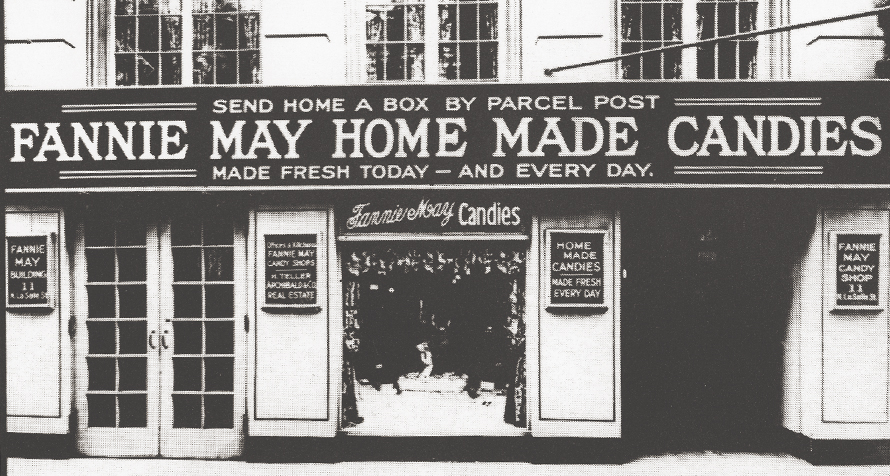
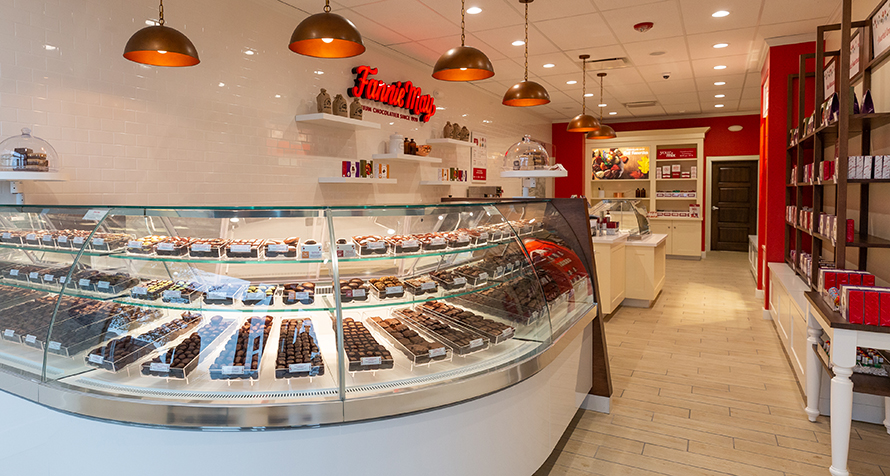
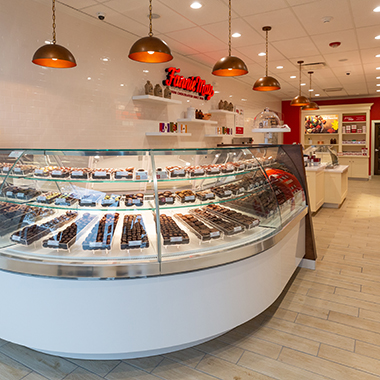
H. Teller Archibald opens the first Fannie May shop in 1920 at 11 N. LaSalle St. in Chicago. By 1935, there are nearly four dozen shops in Illinois and several neighboring states. During World War II, while other companies choose to change their recipes when ingredients were scarce, Fannie May stuck with its exact recipes, making only what it could. Often that means closing shops early because no more candy was available, but never was the taste of the candy compromised. It was his vision to create delicious tasting, handcrafted chocolates. That same commitment to the quality of recipes continues, with most of the same ingredients coming from the same suppliers for many years. Quality has always been the driving force behind the making of Fannie May chocolates.

2004 Fannie May grand opening
As Fannie May’s former parent company became overburden by debt from other acquisitions, Alpine Confections Inc. saw tremendous value in the brand, which is loved by so many in Chicago and around the Midwest. It purchased the Fannie May brand, including the recipes, and pledged to bring back the candy and to reopen shops. More than 45 retail shops in three Midwestern states begin opening again in October 2004, just in time for holiday traditions to continue uninterrupted. Fannie May Confections, Inc. is based in Chicago and includes the Fannie May? and Fanny Farmer? brands. Throughout its history, Fannie May has been a family-owned business and continues to be privately held today. From the shops to the kitchens to the corporate offices, Fannie May employees continue to display pride and passion for providing candy of the highest quality.


Contact Us About Fannie May Affiliate Program Corporate Discounts Fundraising Privacy Policy Disclaimer Terms & Use Site Map
Shop Our Family of Brands
Left3-disabled
Right3-enabled